Three Good Reads
Destigma, nonchange, gendered work search

Getting out and giving back: repertoires of destigmatization in the private social safety net
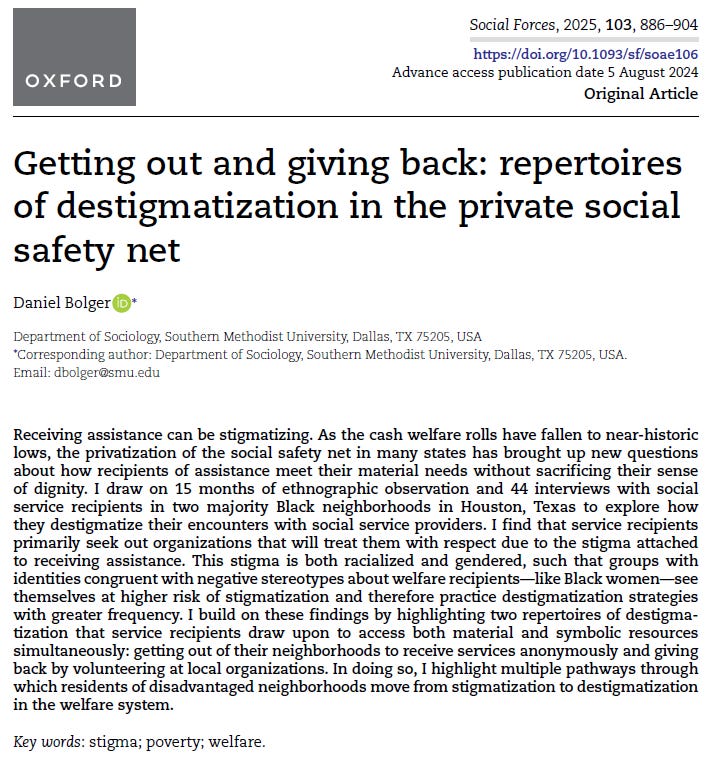
Here we have an interesting interview and ethnographic study of a major blank space in the more social psychological and cultural portion of inequality research: how marginalized folks take certain actions to fight against the stigma that’s associated with receiving social welfare assistance.
We have stigmatization:

Stigma matters because it diminishes social status, and we humans care about social status.
Bolger notices a gaping hole in the sociological literature on stigma:
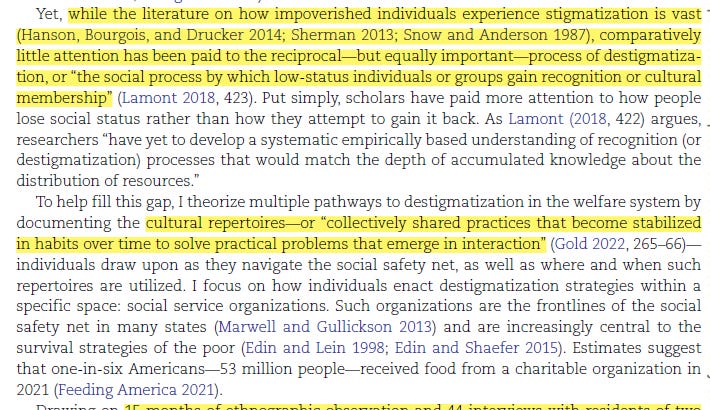
People don’t just fall prey to stigma. They can do things to fight back against it, to not lose social status, to gain it back.
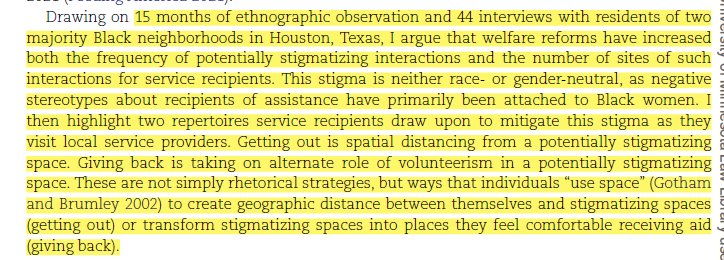
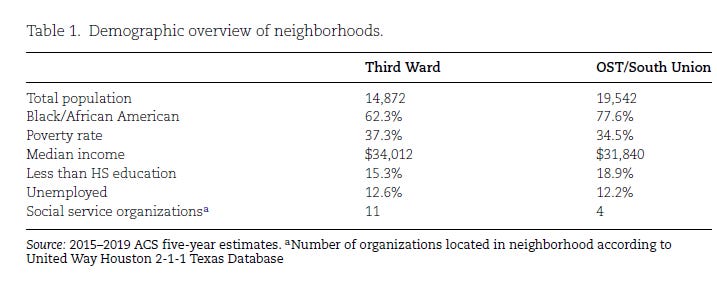
He studies two neighborhoods in Houston, Texas
The two neighborhoods are similar in some ways, but one is more dense with social service organizations than the other:
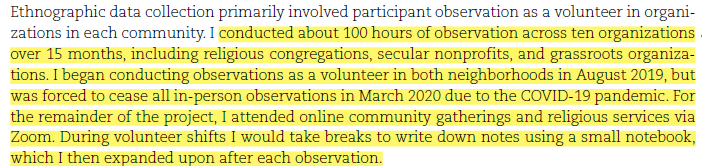
Lots of observational data:
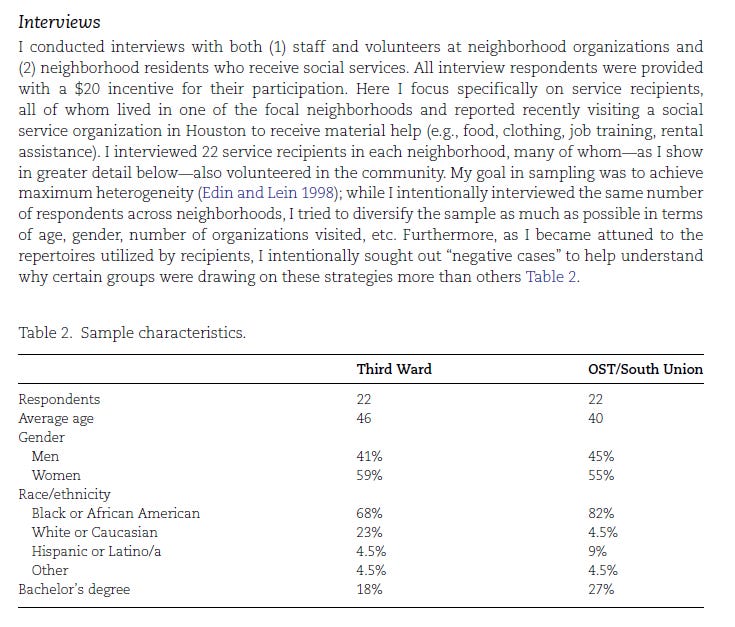
Lots of interview data
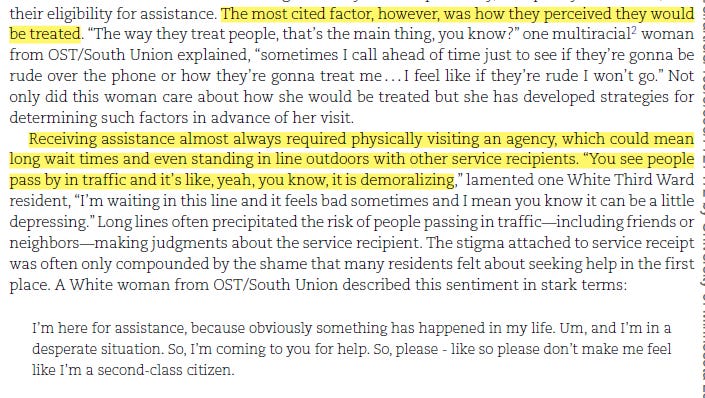
So what helps people decide to pursue social services? Well, one is perceptions of how one will be treated, or potential stigmatization:
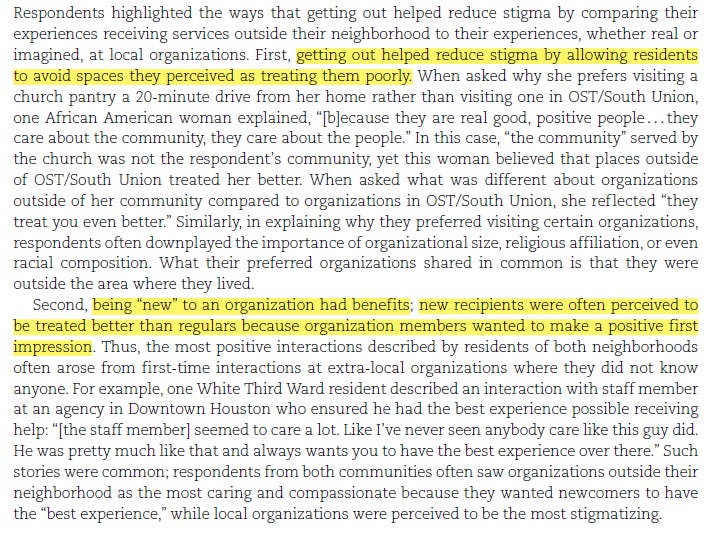
So how do folks fight against stigma? One way is getting out
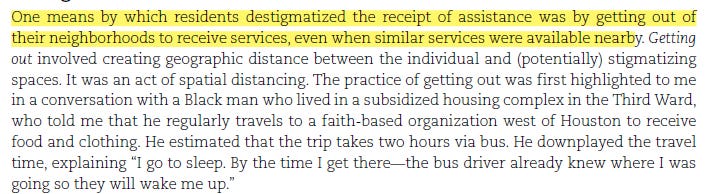
People get out for a number of reasons - histories or stories of poor treatment, perceptions of treatment based on racial identity, long lines, avoiding being seen, being seen as new recipients.
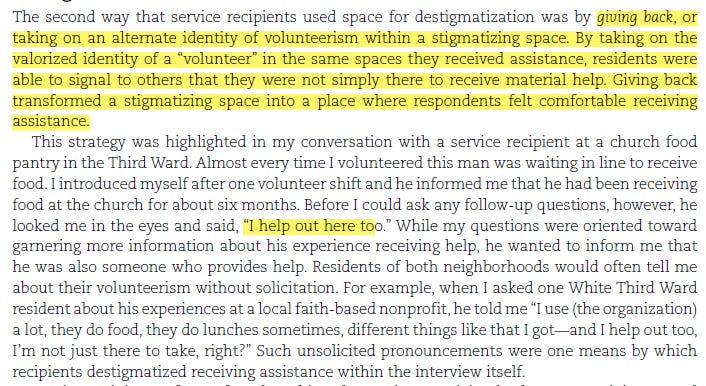
People also destigmatize by giving back:
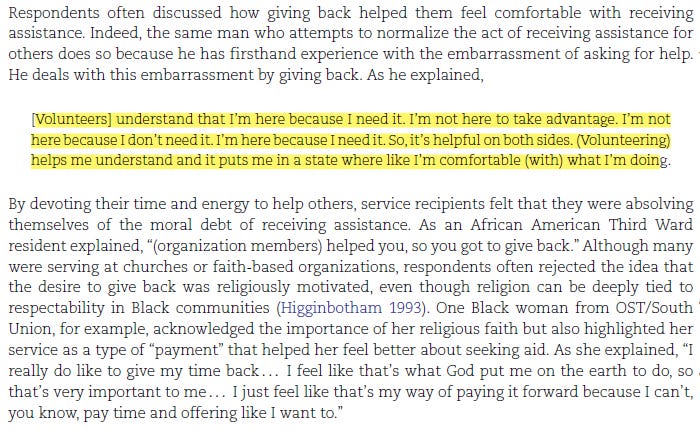
You try and improve the experience for others - you gain psychological benefits from helping others:
The big conclusions:
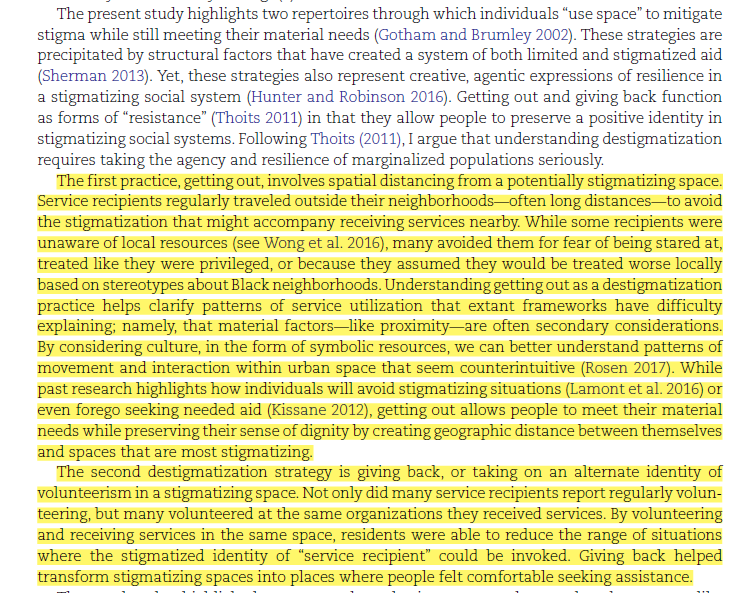
These findings to me are straightforward. The article makes some gestures towards intersectional findings, and towards general theoretical pathways. To be honest, I didn’t see these in the data and I thought they were a tad tacked on to the article. That’s fine - a practical reality of publishing is that you have to puff things up a bit, or you have to stretch a bit to fit the whims of a reviewer’s preference.
When I say the findings are straightforward, I mean that as a big compliment! The author here notices a pretty big literature gap. It’s really cool to learn the strategies that folks take to retain dignity. Building and retaining dignity is really important for everyone from all walks of life. I also love the phrase, “taking agency and resilience of marginalized populations seriously.” Yup - social order is produced through the mix of structure and of agency. It’s too easy to forget the dynamic tension and focus on the former when you’re doing sociological research.
Life-Course Transitions and Political Orientations
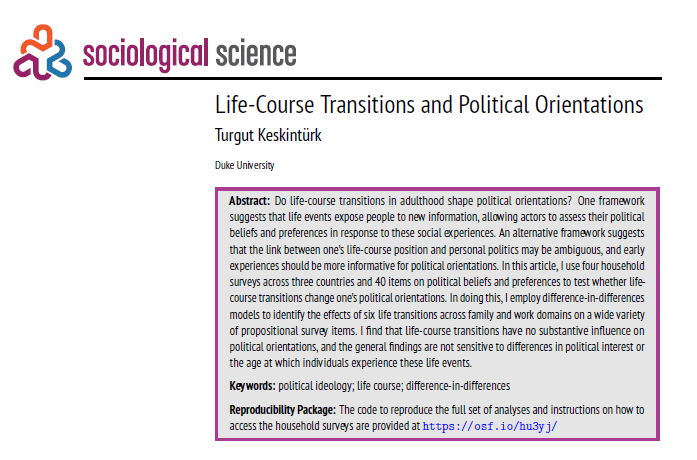
People don’t change their minds. That’s a big argument in the literature on social and political attitudes.
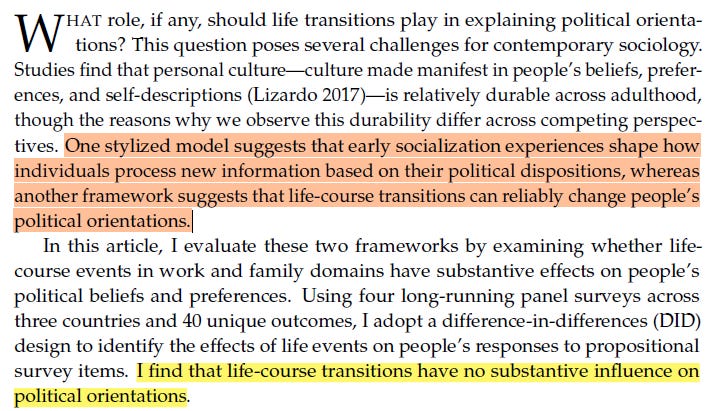
Keskinturk gives a frank summary of his finding:
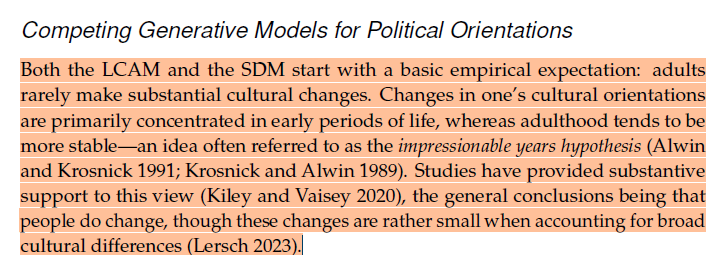
A brief overview of the theoretical stock:

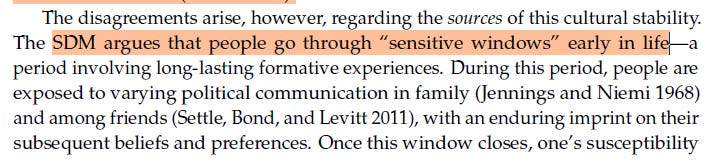
On the SDM side:

On the LCAM side:
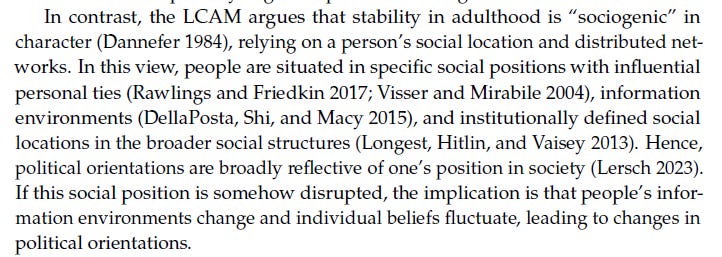
The contrast between the two:
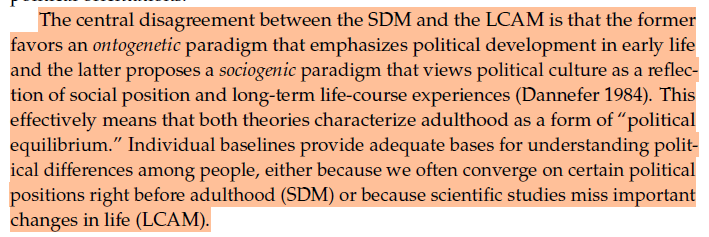
Leading to the basic expectation examined in the article:

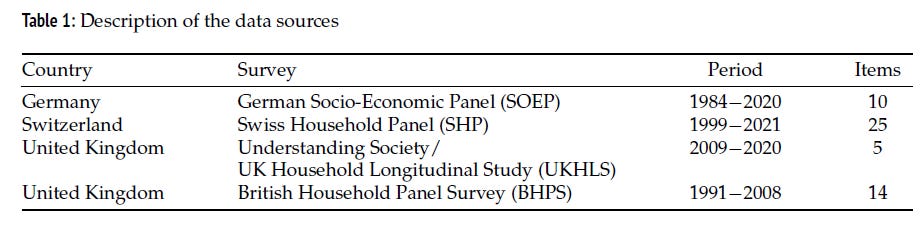
Data come from panel datasets covering life course changes in political orientation in Switzerland, Germany, and the United Kingdom:
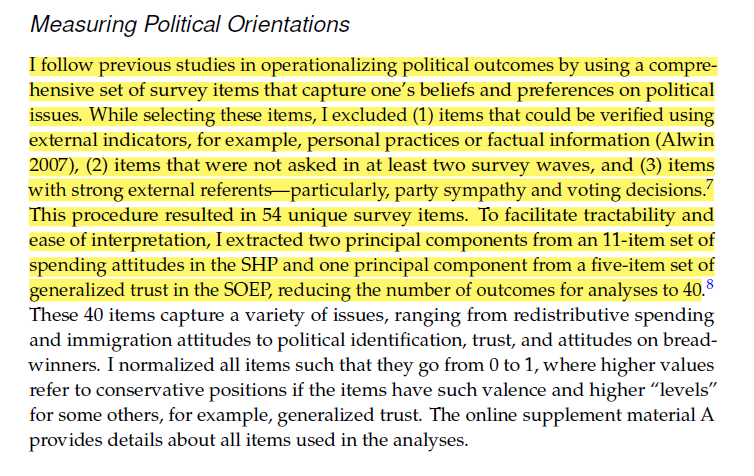
The outcome: a conglomeration of lots of political attitudes
The life course transitions:
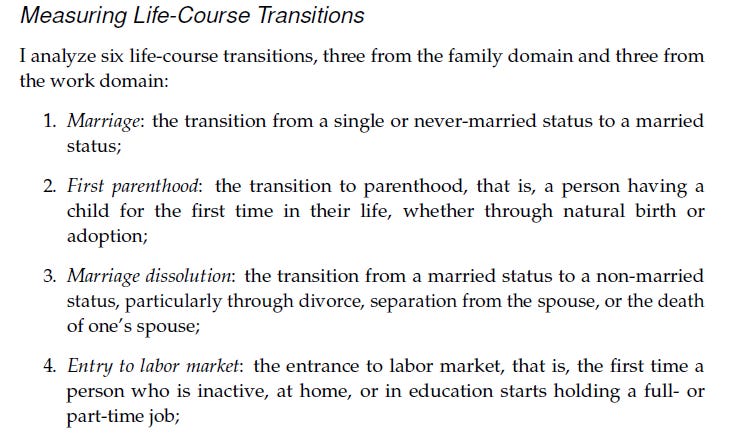

The author uses extensions of difference-in-difference models (the Callaway / Sant’Anna flavor, if you’re interested).
So what’s found?
First, the typical outcome is no change in attitude:
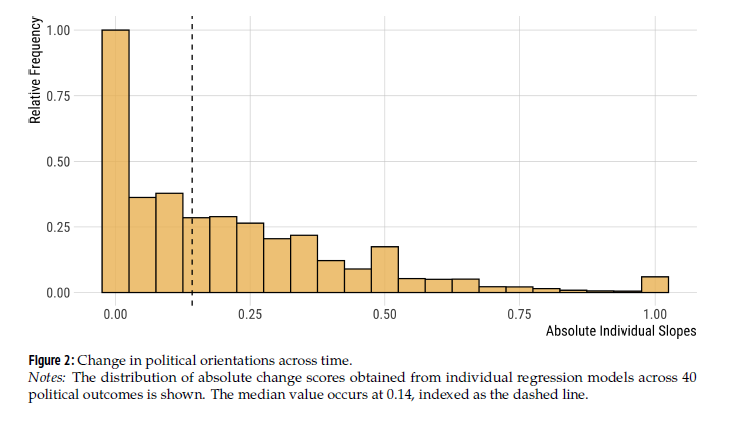
The author’s description:
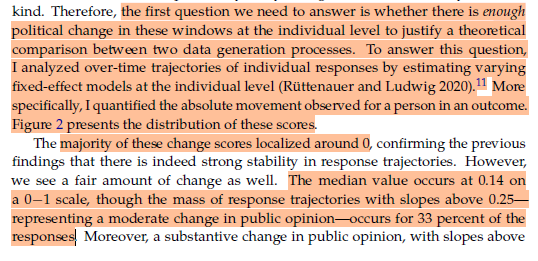
Very little change in attitudes, and the changes are very modest in magnitude
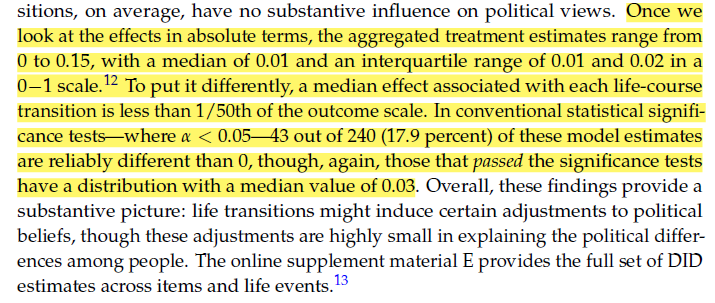
If we look at attitude trends over time, there is not a whole lot going on
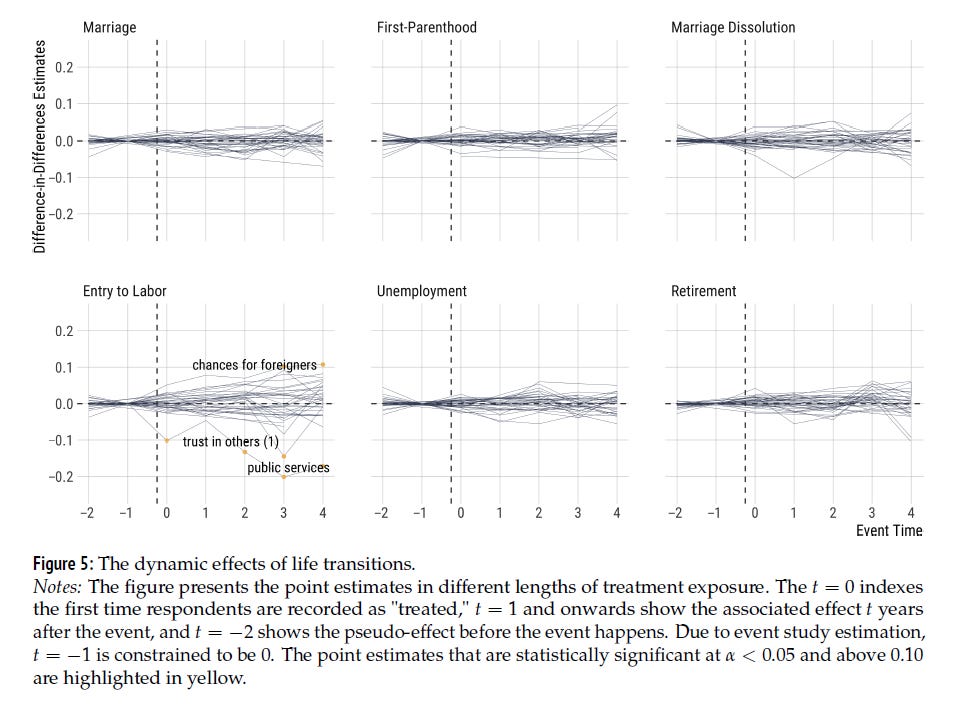
The author does a bunch more digging into potential effect heterogeneity, and continues to come to the conclusion: “meh, not much change.”
The overall conclusion:
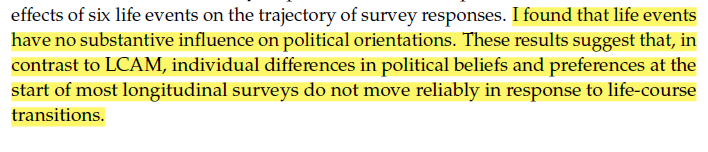
The author spends a long time at the end of the article thinking about the potential limitations and extensions that are needed to further interrogate the question of political attitude change. I thought this rumination was nice, but noticed that it stayed within the logic of: using long-run panel datasets to examine attitudes measured by survey items.
This led me to think: why, when, and how do people actually change their views over time? It’s one thing to notice stability and change in how folks answer questions about generalized trust, for example. But it’s another thing to understand the stable meaning across changing responses, or changing meaning to stable responses, that might reflect a person’s changing mind. I wish there was some 3 or 4 decade interview with people that let us see how minds changed and didn’t, that let people discuss how their views have changed over time. That is - I wonder if we need a blend of life course perspective and qualitative research to get at the heart of the matter. But nevertheless - very interesting and well done study.
Gendered Job Search: An Analysis of Gender Differences in Reservation Wages and Job Applications
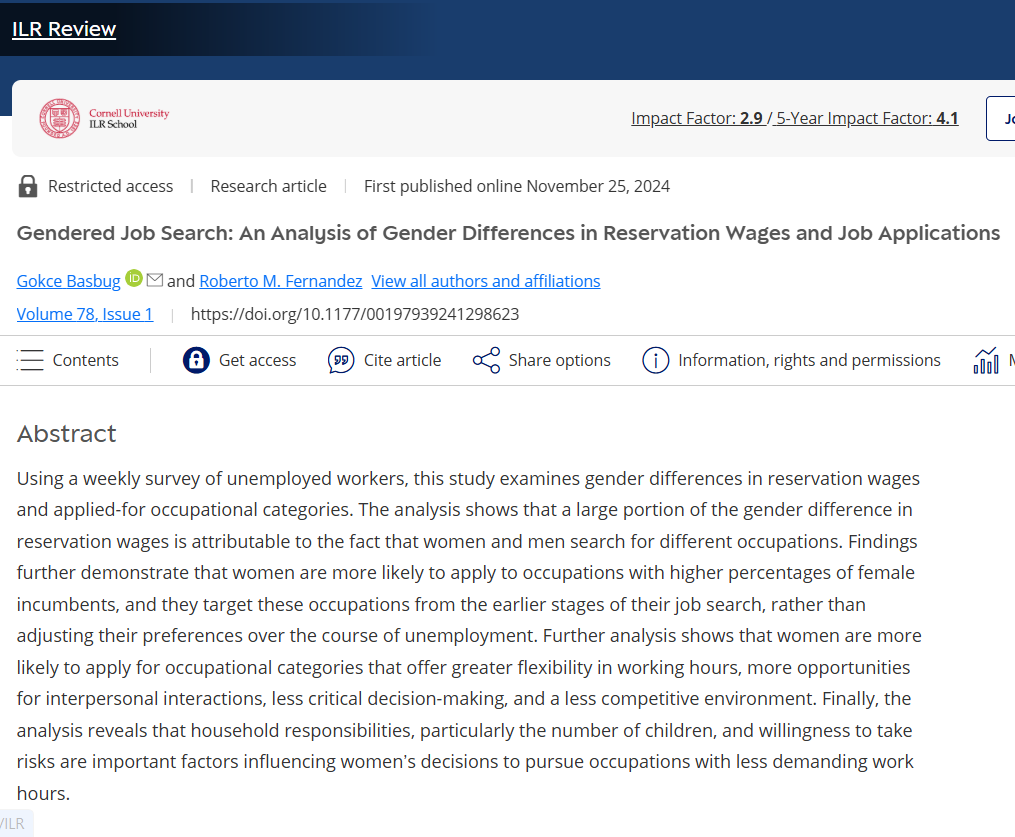
Basbug and Fernandez conduct an interesting study of the gendered nature of job searches. Fernandez is famous for his mix of: crankiness, intelligence, and not letting claims slide without empirical backing. I’ve never met him, but his reputation precedes him.
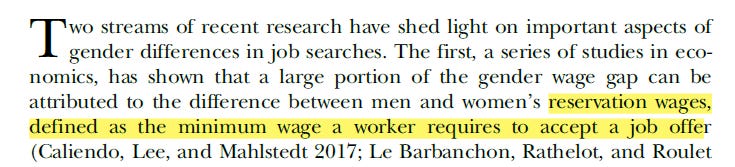
They’re looking at a contrast of factors that lead to different job searches between men and women. The first, from economics, is the reservation wage:
The second, from organizational studies and the crown jewel of the social sciences (sociology) is different search patterns:
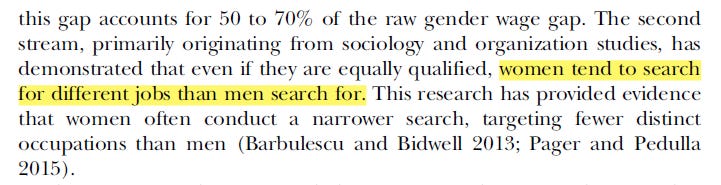
BF are writing less of a paper that puts these perspectives in competition and more of a paper asking, when and how do these two mechanisms matter.
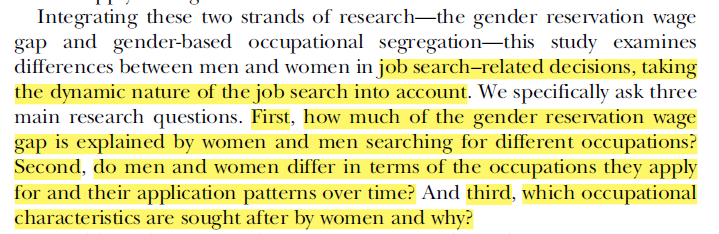
They use a very cool dataset to examine the job search process that measures the reservation wage of job seeking folks and the types of jobs they search and apply for.
This lets BF ask interesting questions like: do men and women have the same reservation wage when they are applying to the same occupation? Do men and women apply to jobs with similar or different characteristics?
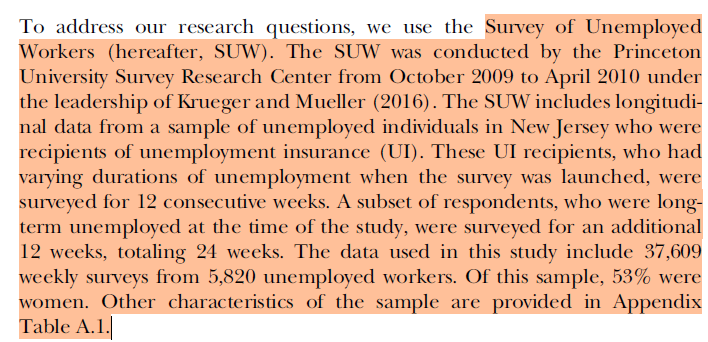
The data source:
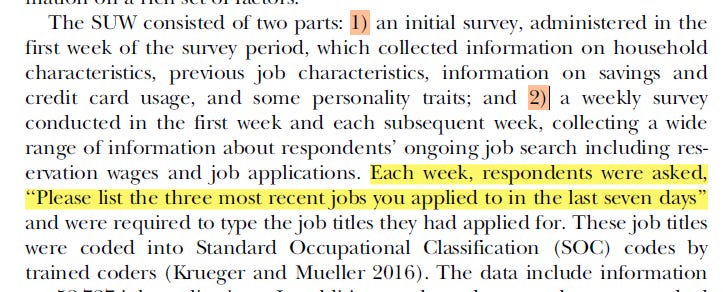
The two chunks of the SUW data
Their first finding: men had much higher reservation wages than women

However, this difference in reservation wage primarily refers to gender occupational segregation
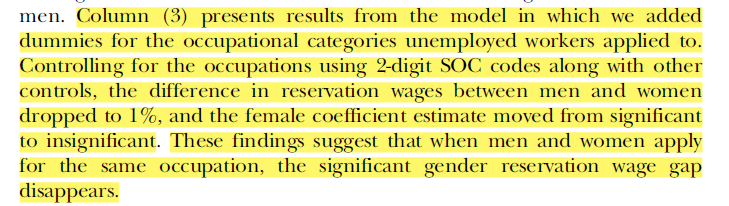
We see the change in significance between models 2 and 3 below for the “female” indicator
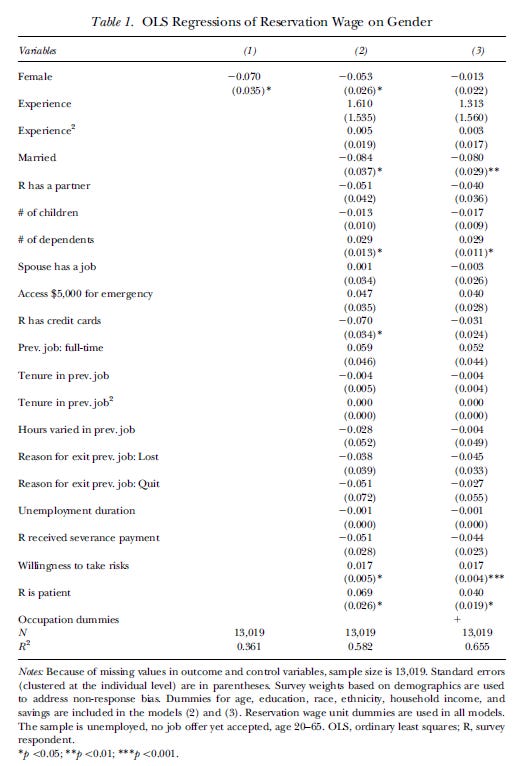
If you decompose the contribution to the gender difference in reservation wages, the list of factors in the above table explain a little over 40% of the gap. And occupations explain another roughly 40%
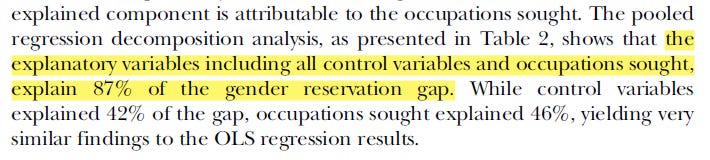
Men and women typically apply to jobs with more men and women already employed, respectively

The first row of the following table
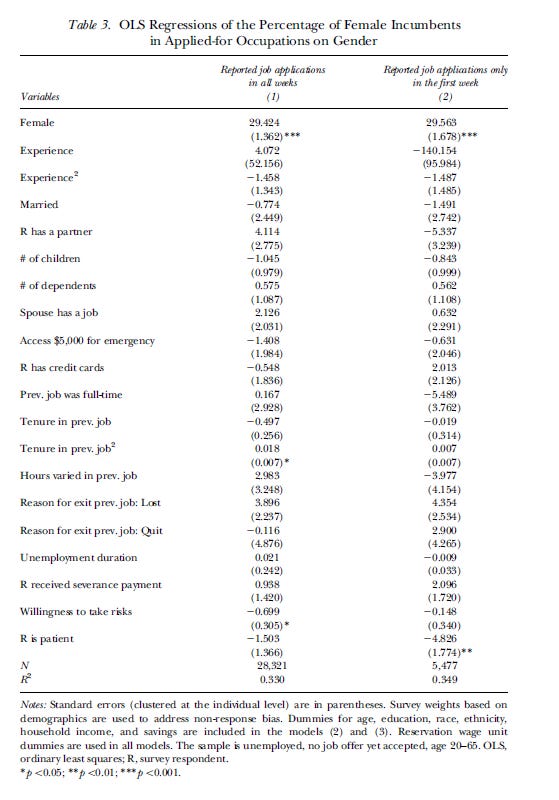
The similarity of the two columns show that the gendered nature of job searches doesn’t emerge - it’s kind of a stable process:

If you examine trends in the gender composition of occupations applied to over time, you don’t see much change in either men or women. So we see a general gendered search process.
Women and men apply to jobs with different characteristics:
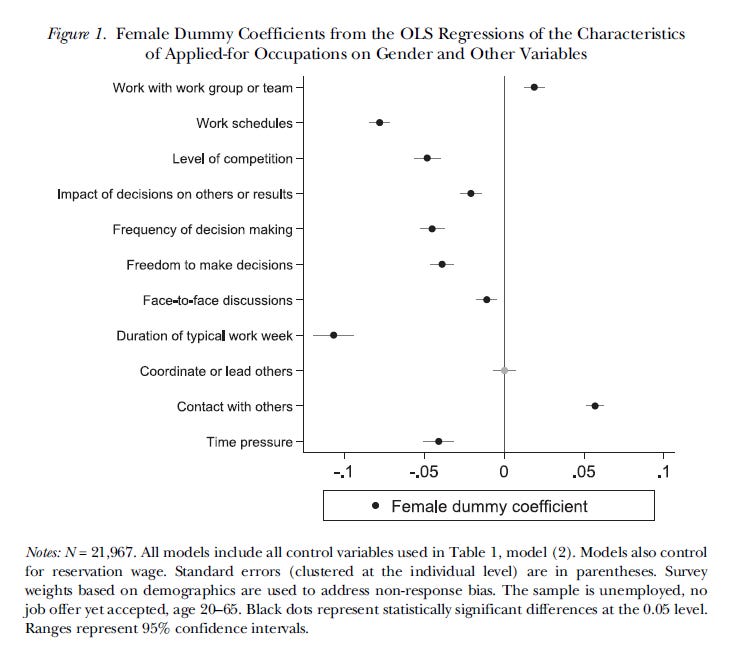
In general: women have higher rates of applications for working in groups or teams and having contract with others. Men have higher application rates for longer work weeks, more time pressure (those are the biggest contrasts I see).
A lot of this has to do, unsurprisingly, with parenthood. See the below table and the highlighted general finding:
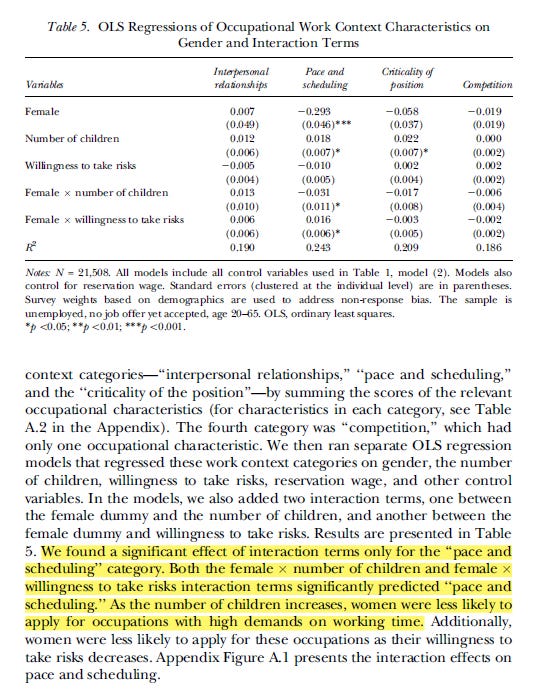
The overall finding:
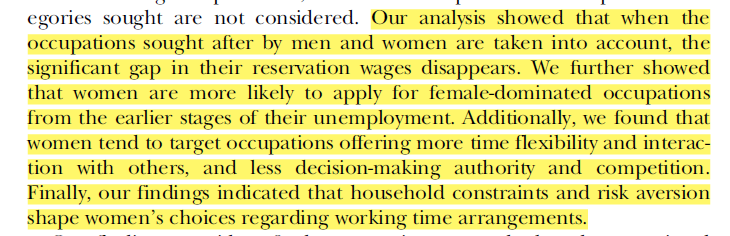
A few random thoughts:
I love the project’s data. It is so cool to be able to track respondent job applications. A very nice way to examine a difficult-to-observe portion of the inequality process.
From my perspective from sociology, we see a few things. First, there was a paper a decade ago by Younjoo Cha and Kim Weeden that showed that intensive work schedule occupations had higher pay, and that the sorting into these kinds of occupations had a big contribution to the gender pay gap. We see a similar finding here. Second, we see that work that is more demanding and greedy for a person’s time is bad for gender inequality. My gut is that there are some utopian hopes among folks that mass and aggressive daycare administration can overcome this. But speaking as a pretty invested parent myself, the presence of children simply closes off certain opportunities for aggressive, “all in” work. There is no way around this, and I think it may make more sense to ask whether it makes sense to either allow, glorify, or enable major inequalities of opportunity between those opting into “all in” work and those who have a mix of social and work obligations. Because childcare obligations are highly gendered, it’s easy to think of this as a gender issue. But I think it more deeply reflects a question of unequal opportunity and implicit social engineering - e.g. structuring opportunity in favor of those who will sacrifice all for work, creating a system of norms surrounding the choices people make to live their lives.
Overall, a fascinating study that seems to reinforce some of the major sociological findings of gender inequality. We need to think about occupational segregation and the mismatch between being able to be part of high paying work and being able to be part of a broader life. Very cool!